The Federal Contracting Pipeline Part 6 of 8 | How to Price a Government Contract Without Leaving Money on the Table
Federal contract pricing isn't a number you pull from instinct or competitive comparison. It needs to be defensible, traceable back to real costs, structured around direct and indirect cost categories, and calibrated to the contract type you're bidding.

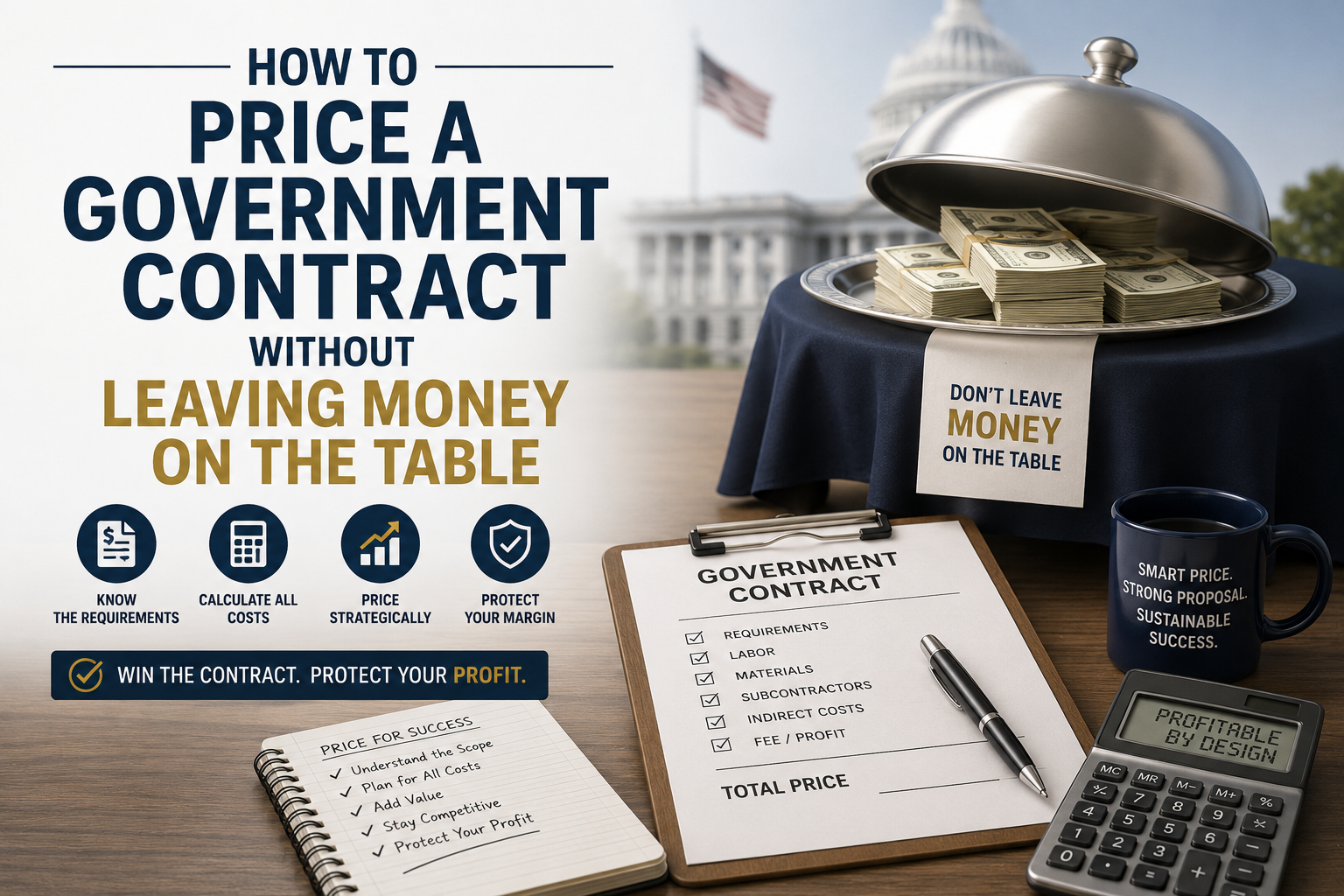
Most small businesses underprice their first government contract. Not because they don't know their costs, but because they don't know how government pricing actually works. The structure is different. The vocabulary is different. And the mistakes are expensive.
This installment breaks down the mechanics of federal contract pricing: how to build a legitimate cost structure, which contract types put more risk on you, and where small businesses quietly lose margin they should have kept.
Why Government Pricing Is Different
In a commercial transaction, you name your price and the buyer decides. In federal contracting, the government has a strong interest in understanding how you arrived at your price, especially on contracts above the simplified acquisition threshold (currently $250,000). They may ask for a cost breakdown. They may compare your rates to market data. They may negotiate.
That means your pricing can't just be a number pulled from instinct or competitive comparison. It needs to be defensible, traceable back to real costs you can document.
That doesn't mean you can't make a margin. It means your margin has to be built into a structure, not added on top of a guess.
The Cost Structure: What Goes Into a Government Price
Federal pricing is built on a foundation of cost categories. Understanding these is non-negotiable before you write a number on a proposal.
Direct Costs
These are costs that can be tied directly to the contract work:
• Direct labor - the hours and rates for the people doing the work
• Direct materials - supplies, equipment, or goods purchased specifically for this contract
• Subcontractor costs - if you're using subs, their costs flow through as a direct cost
Your direct labor rate is not just the wage. It includes the loaded rate — base pay plus benefits, payroll taxes, and any other direct compensation costs tied to that employee.
Indirect Costs
These are costs that support your business but can't be tied to a single contract:
• Fringe benefits - health insurance, retirement contributions, paid leave
• Overhead - rent, utilities, administrative staff, software
• G&A (General and Administrative) - executive salaries, accounting, business development
Indirect costs are typically expressed as rates applied to direct costs. Your fringe rate might be 25% of direct labor. Your overhead might be 40%. Your G&A might be 15%. These rates get applied on top of your direct costs to arrive at your total cost before profit.
KEY POINT: If you don't know your indirect cost rates, you're guessing. Many small businesses skip this step and either underprice (losing margin) or overprice (losing the bid).
Fee / Profit
Profit in government contracting is typically called "fee." It's negotiated and influenced by contract type, risk level, and how competitive the market is. For small businesses, it's often in the 8–12% range on cost-reimbursable contracts - though fixed-price contracts can yield higher effective margins if you price and perform efficiently.
Contract Types and What They Mean for Your Risk
The contract type determines who absorbs the financial risk if actual costs come in higher than estimated. Knowing the difference is one of the most important pricing decisions you'll make.
Firm Fixed Price (FFP)
You agree to deliver the work at a fixed price, no matter what it costs you. If you underestimate, you absorb the loss. If you're efficient, you keep the upside.
FFP is common for well-defined, low-risk work where scope is clear. For experienced contractors with good cost data, it can be profitable. For new businesses without a cost history, it's a risk - especially if scope creep is possible.
WATCH FOR: Scope that is vaguely defined. On an FFP, you're responsible for any ambiguity that wasn't clarified before contract award. Nail the SOW before you price.
Cost-Reimbursable (CR)
The government reimburses your actual allowable costs plus a negotiated fee. Your financial risk is lower - but so is your upside. You won't lose money if costs run over, but you won't make a killing either.
These contracts require more accounting overhead. You'll need a compliant accounting system (more on that below). They're common for R&D, services with uncertain scope, or longer-term engagements.
Time and Materials (T&M)
You bill at fixed hourly rates for time, plus actual cost for materials. The rate includes your costs and profit baked in. T&M is capped - the government won't pay past the ceiling without a modification.
T&M is common for IT support, maintenance, and professional services where hours are variable but rates are stable. Know your fully loaded cost per hour before you set your bill rate.
RULE OF THUMB: The more defined the scope, the more you can consider fixed-price. The more uncertain or variable the work, the more you want cost-type or T&M protection.
The Pricing Mistakes That Quietly Kill Small Business Margins
1. Using Your Commercial Rates Without Adjustment
What you charge a private client isn't necessarily what you should charge the government. Government contracts often require compliance costs - reporting, certified payroll, accounting systems, security clearances - that your commercial work doesn't. Those compliance costs need to be priced in.
2. Forgetting Escalation on Multi-Year Contracts
If you're bidding a three-year IDIQ or base-plus-options contract, your Year 1 rates can't just be copy-pasted into Years 2 and 3. Labor costs go up. Materials escalate. Build in escalation - typically tied to CPI or negotiated annual rate adjustments — or you'll be losing ground every year you perform.
3. Ignoring the Cost of Proposals
Proposals take time. That time has a cost. Some contractors spread proposal costs across their G&A rate so they're recovered across all contracts. Others price it in explicitly on larger bids. Either way, the cost of chasing work is real - don't let it be invisible.
4. Not Knowing Your DCAA Exposure
The Defense Contract Audit Agency (DCAA) audits government contractors, particularly on cost-reimbursable work. If your accounting system isn't compliant, you can't bid cost-type work - and if you're already performing it, you're exposed. Know your audit risk before you price for work that requires it.
5. Underpricing to Win, With No Plan to Fix It
Some contractors buy their first contract by pricing aggressively - below true cost - to get past performance. That strategy has a shelf life. If you can't perform profitably, your first contract becomes a liability. Price to win and perform, not just to win.
A Simple Pricing Sanity Check
Before you submit a price, answer these four questions:
• Can I trace every line item back to a real cost?
• Have I included all indirect costs at current rates - not estimates from two years ago?
• Does my price account for the risk allocation in this contract type?
• If I win and perform this contract, will I actually make money?
If you can't answer yes to all four, your price isn't ready.
Up Next in Part 6: Past Performance — Building a Track Record When You Don't Have One Yet. We'll cover how to document experience, what counts as relevant past performance, and how to compete against incumbents with longer histories.
© 2026 Published by Evans Cutchmore, an Imprint of The Couvent Collective PBC. All rights reserved.
Kim M. Braud is a strategist, writer, and founder working in the areas of economic power, cultural narrative, and community leadership. With expansive experience across financial services, entrepreneurship, and nonprofit leadership, her writing explores who controls systems, who benefits from them, and who gets left out. Her work centers on economic mobility, institutional accountability, and the stories we inherit, and the ones we choose to dismantle.
Before You Submit, Get a Strategic Eye on Your Response
Responding to an RFP without a strategic review is one of the fastest ways to lose a contract you were qualified to win. Evaluators score on specifics, and most responses miss the mark not because the business is not capable, but because the response did not speak the language of the solicitation.
This service is for founders and business owners who have an RFP in hand and need an experienced advisor to review the document, identify what evaluators are actually looking for, and provide structured feedback on their draft response before it is submitted.
What is included: Full review of the RFP or solicitation document. Written feedback on your draft response covering alignment, gaps, tone, and scoring criteria. Actionable notes on sections that need strengthening. One follow-up exchange via email to address questions after feedback is delivered. One-hour review session.
This is for you if: You are responding to a government, corporate, or institutional RFP and you have a draft response ready for a second set of strategic eyes before submission.
Not included: Full response writing or rewriting. If you need a response written from scratch, contact us to discuss a custom engagement.
Turnaround: 3 to 5 business days from receipt of documents. A list of qualifying questions will be forwarded to you within 24 hours, followed by a scheduled Zoom prior to delivery of recommendations.