Revenue Is Not Profit
Social media loves a revenue screenshot. But gross revenue is a starting line, not a finish line. Before you scale anything, you need to understand what's left after overhead, payroll, insurance, and acquisition costs eat their share. That's the number that runs your business.

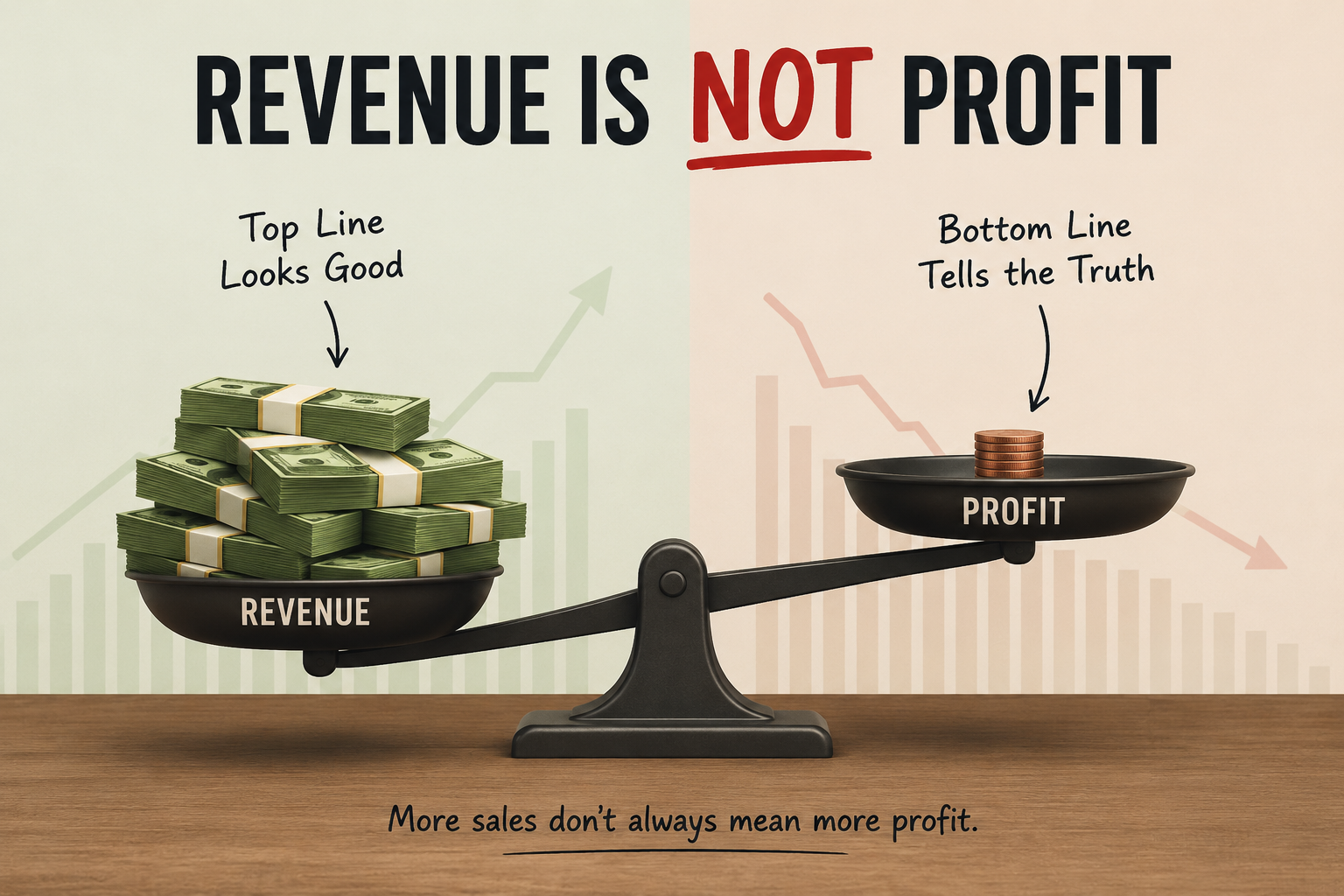
What the screenshot crowd doesn't want you to know about your numbers.
You've seen them. The screenshot. A payment processor dashboard. A Shopify revenue summary. A bank deposit confirmation. Six figures. Maybe seven. Posted with a caption that reads something like: "This month. Just me and my laptop. God is good."
And somewhere in the comments, someone types: "How??"
Here's the answer nobody posts a screenshot of: those numbers are gross revenue. And gross revenue, by itself, means almost nothing.
A business that brings in $500,000 and spends $490,000 is not a successful business. It is a very busy broke one.
This post is about the numbers that actually matter, and why every operator, regardless of industry, needs to understand the difference between revenue and profit before they scale anything.
What Gross Revenue Actually Tells You
Gross revenue is the total amount of money that came in the door before anything was subtracted. Before you paid your team. Before you covered your rent or your platform fees. Before insurance, before taxes, before the cost of making or delivering whatever it is you sold.
It is a starting line, not a finish line.
Gross revenue is useful for one thing: understanding the top-end size of your business. It tells you how much volume you're moving. That's it. Every other meaningful question - Is this profitable? Can I grow? Am I paying myself fairly? - requires you to go further.
The business owners who confuse revenue for success are also the ones who are constantly busy, constantly generating sales, and constantly wondering why there's never any money left.
The Cost Structure Beneath Every Dollar You Earn
Profit is what remains after costs. And costs have layers. Let's walk through the ones that quietly consume revenue in almost every type of business.
Overhead
Overhead is the baseline cost of being open. It exists whether you make a single sale or a thousand. Rent or mortgage on your space. Utilities. Software subscriptions. Equipment maintenance. Internet. Phone. Web hosting. Accounting software. Your bookkeeper's monthly retainer.
Overhead is easy to underestimate because many of these costs are small individually. A $29/month tool here. A $79/month subscription there. But when you add them together, especially as you grow and add more tools, more space, more equipment, overhead becomes a significant monthly obligation that you have to earn against before profit begins.
If your overhead is $8,000/month and your revenue is $12,000/month, you are not making $12,000. You are making $4,000 — before everything else on this list.
Insurance
Insurance is one of the most commonly skipped costs in early-stage businesses, and one of the most dangerous to skip.
Depending on your business type, you may need general liability insurance, product liability coverage, commercial auto, workers' compensation, professional liability (errors and omissions), property insurance, or some combination of all of them. Service businesses need it. Product businesses need it. Manufacturers need it. Logistics operators need it in multiples.
The cost varies widely by industry and coverage level, but it is never zero. And if you're not factoring insurance premiums into your cost structure, your margin calculations are wrong.
An uninsured claim doesn't just affect this month's revenue. It can eliminate the business.
Payroll
Payroll is typically the largest cost in any business with employees — and it's larger than most business owners expect when they're calculating it for the first time.
The cost of an employee is not their salary. It is their salary plus employer-side payroll taxes (Social Security, Medicare, federal and state unemployment contributions), plus any benefits you offer — health insurance, retirement contributions, paid time off. Depending on your state and your benefits package, the true cost of an employee can be 20 to 40 percent higher than their base wage.
This matters for small businesses that are trying to decide whether they can afford to hire. The question is never "Can I afford this person's salary?" The question is "Can I afford the full loaded cost of this person, including taxes and benefits, every month, even in a slow month?"
And don't forget to pay yourself. If you're a solopreneur who is running a $200,000-revenue business but not factoring in your own compensation as a cost, your profit number is fictional.
Cost Per Acquisition
This is the cost you incur to bring in each new customer or client. It includes advertising spend, marketing tools, sales commissions, referral fees, and the time your team spends on outreach and follow-up.
Cost per acquisition (CPA) is where businesses that appear to be thriving often discover they are actually losing money at the transaction level.
If you spend $150 in ads and time to acquire a customer who pays you $175 for a one-time order, your profit on that transaction - before overhead, COGS, or any other costs - is $25. That is a thin margin with no room for error.
Understanding your CPA requires tracking it. That means knowing how much you spend on marketing and sales per period, how many customers that spending generates, and what those customers spend on average. The businesses that grow sustainably are the ones that actively manage this number — reducing CPA through better targeting, retention strategies, and referrals, while increasing average customer value through upsells and repeat purchases.
This applies whether you're a candle maker running Facebook ads, a logistics company paying a sales team, an author investing in a book launch, or a contractor responding to RFPs.
Margin Discipline
Gross margin is what remains after you subtract the direct cost of producing or delivering your product or service - the cost of goods sold (COGS) or cost of services - from revenue. Net margin is what remains after everything: overhead, payroll, insurance, acquisition costs, taxes.
Margin discipline means you know what your margins are, you protect them deliberately, and you do not make growth decisions without understanding how they will affect margin.
This is where a lot of scaling decisions go wrong. A business owner sees growing revenue and decides to hire, expand, or take on new customers - without first confirming that their margins can support that growth. They add cost before confirming profit. And when the higher revenue doesn't translate to higher profit, they're confused.
Margin discipline looks like this:
• Knowing your gross margin percentage on every product or service line
• Setting a floor - a minimum margin below which you do not take a job or sell a product
• Reviewing your cost structure regularly, not just when something goes wrong
• Raising prices when costs rise, rather than absorbing the hit to margin
• Being willing to turn down revenue that doesn't meet your margin requirements
That last one is hard. But a contract that pays $50,000 and costs you $48,000 to fulfill is not an asset. It is a cash flow drain with extra paperwork.
This Is Not Industry-Specific. It Is Business.
The cost categories above apply regardless of what you do or what you sell.
A candle maker running wholesale accounts has overhead (studio rent, utilities, packaging materials), COGS (wax, fragrance, wicks, jars), payroll (even if it's just part-time help), and a cost per acquisition (the time it takes to pitch and onboard wholesale accounts). Their margin on a $12 wholesale candle may be thinner than they think.
A logistics operator has significant overhead (equipment, technology, facilities), insurance requirements that are among the most complex in any industry, payroll and driver costs that fluctuate with volume, and acquisition costs tied to RFPs, bid preparation, and sales cycles. Their revenue screenshots - if they're doing seven figures - are not impressive without context.
An independent author running their own publishing operation has overhead (editing, cover design, formatting, platform fees), COGS (printing costs for print editions, advertising for launch), and an acquisition cost that often runs surprisingly high per book sold. Their margin on a $14.99 paperback is not $14.99.
A small government contractor has bid and proposal costs (which are real costs, paid whether they win or lose), project overhead, payroll for billable staff, and compliance costs. A contract win is a starting point, not a profit confirmation.
Every one of these businesses has revenue. Not all of them have profit.
What to Do With This
If you have not looked at your actual cost structure recently, or ever, start there.
Pull your last three months of bank and credit card statements. Categorize every expense: overhead, payroll, cost of goods/services, marketing and acquisition, taxes, and everything else. Add them up.
Then subtract that total from your revenue.
That number - not the one on the payment screenshot - is the one that tells you how your business is actually doing.
If the number is positive and healthy, build on it. If it's thin, identify which cost category is eating your margin and address it directly. If it's negative, you need that information now - not six months from now.
Revenue is how much money came in. Profit is how much of it you actually kept. The goal is to keep as much as possible, consistently, over time.
Stop managing your business by the top line. Start managing it by what's left after everything else. That's the number that matters.
Kim M. Braud is a strategist, writer, and founder working in the areas of economic power, cultural narrative, and community leadership. With expansive experience across financial services, entrepreneurship, and nonprofit leadership, her writing explores who controls systems, who benefits from them, and who gets left out. Her work centers on economic mobility, institutional accountability, and the stories we inherit, and the ones we choose to dismantle.