Why Your Vision Board Isn't Working (And What to Do About It)


Vision without tactics is a daydream. Tactics without vision are a nightmare.
Let me be real with you for a second.
Every January, millions of people create beautiful vision boards. They cut out magazine pictures of dream homes, tropical vacations, and six-pack abs. They pin inspirational quotes to Pinterest. They buy fancy journals and write down their goals in perfect handwriting.
And by February? Those vision boards are collecting dust.
Here's the uncomfortable truth: Pretty pictures don't build businesses. Inspirational quotes don't generate revenue. And hoping for change without a tactical plan is just wishful thinking dressed up as manifestation.
I've spent 15+ years in business, built multiple companies, and mentored countless entrepreneurs. And I can tell you this with absolute certainty: the difference between dreamers and achievers is tactical planning.
The Problem with Traditional Vision Boards
Traditional vision boards focus on the what without addressing the how.
They're great for visualization. They're terrible for execution. And in business, execution is everything.
Traditional vision boards tell you:
• What success looks like
• What you want to achieve
• How amazing you'll feel when you get there
But they don't tell you:
• What specific actions do you need to take this week
• How to measure if you're actually making progress
• What to do when you hit obstacles (and you will)
• How to adjust when life throws you curveballs
That's the gap. And it's costing you your dreams.
Why SMART Goals Actually Matter
You've probably heard of SMART goals before. Specific, Measurable, Achievable, Relevant, Time-bound. It sounds like corporate jargon, right?
But here's why this framework has stood the test of time: it forces you to get honest with yourself.
Let's take a common goal: "I want to grow my business."
That's not a goal. That's a wish. Now let's make it SMART:
Specific: I will increase monthly recurring revenue by securing 10 new B2B clients.
Measurable: Each client will generate a minimum of $2,000/month, totaling $20,000 in new MRR.
Achievable: Based on my current conversion rate of 20%, I need to generate 50 qualified leads through LinkedIn outreach and referral partnerships.
Relevant: This aligns with my goal to scale to $1M ARR and move away from one-off project work.
Time-bound: I will achieve this by June 30, 2025, giving me Q1 and Q2 to execute.
See the difference? One is a daydream. The other is a battle plan.
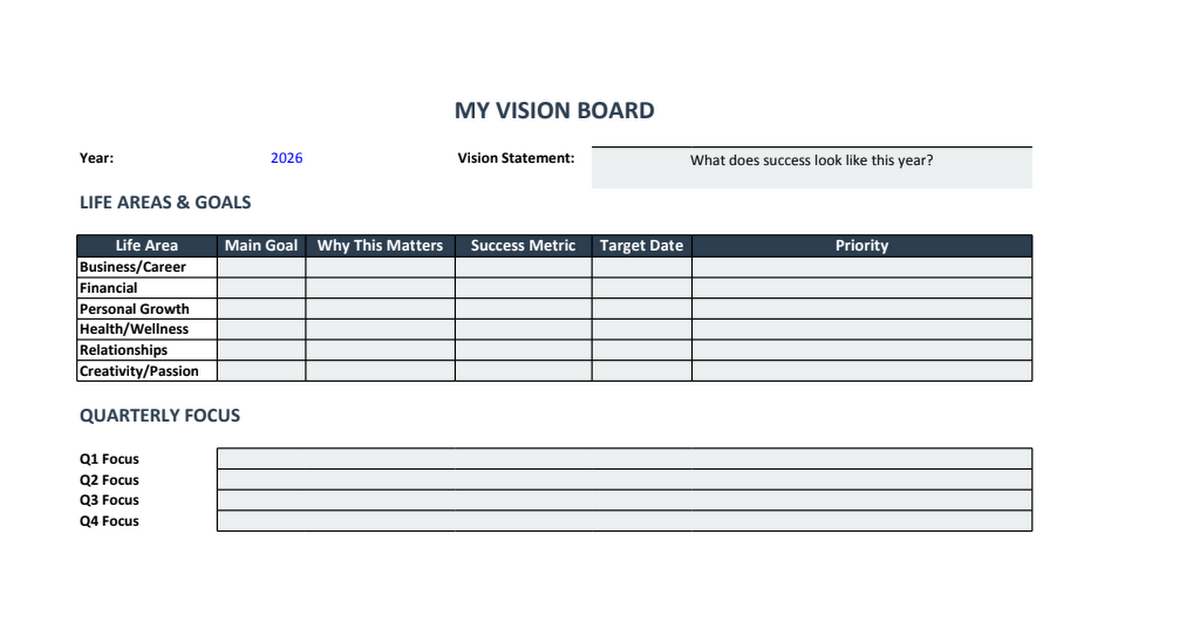
Introducing the Vision Board Tactical Spreadsheet
I created this tool because I was tired of seeing talented people fail, not because they lacked vision, but because they lacked systems.
This isn't just another template. It's a complete tactical planning system that bridges the gap between where you are and where you want to be.
What Makes This Different
It forces clarity. You can't skip steps. Every goal requires a SMART breakdown, success metrics, and action items.
It tracks reality. Built-in progress tracking shows you exactly where you're winning and where you're stuck.
It demands accountability. Weekly and monthly check-ins ensure you're not just setting goals but actually working them.
It adapts with you. Reflection sections help you pivot when something isn't working instead of abandoning your goals entirely.
How to Use the Spreadsheet
This isn't a set-it-and-forget-it tool. It's a living document that you'll work with weekly. Here's exactly how to maximize it:
Week 1: Initial Setup (Budget 2-3 Hours)
Vision Overview Sheet: Start here. Identify your 6 main goals across different life areas: Business/Career, Financial, Personal Growth, Health/Wellness, Relationships, and Creativity/Passion. For each goal, answer WHY it matters and define your success metric. This is your foundation.
SMART Goals Sheet: Take each goal and break it down. Don't rush this. A well-defined SMART goal is worth 10 vague aspirations. List 3-5 key actions for each goal. These should be concrete, doable steps.
Quarterly Milestones Sheet: Break your annual goals into quarterly milestones. What needs to happen in Q1? Q2? This prevents the December panic when you realize you haven't started your goals yet.
Weekly Routine (15-20 Minutes Every Monday)
Review last week: What did you complete? What fell through? No judgment, just data.
Update Monthly Action Plan: Check off completed items. Move unfinished tasks forward or eliminate them if they're no longer relevant.
Plan this week: Assign 3-5 action items for the coming week. Be realistic about your time and energy.
Update Progress Dashboard: Input your completion percentages. Track your habits. Watch your progress compound.
Monthly Review (30-45 Minutes End of Month)
This is where the magic happens. Set aside time for deep reflection:
Wins: What worked? Celebrate it. Write it down. Do more of this.
Challenges: What didn't work? Why? Be brutally honest. This isn't failure, it's feedback.
Adjustments: What needs to change? Update tactics. Shift resources. Pivot strategies. Your goals may stay the same, but your approach should evolve.
Quarterly Reset (1-2 Hours Every 3 Months)
Every quarter, zoom out:
• Review your overall progress percentages
• Identify patterns in what's working and what isn't
• Set milestones for the next quarter
• Adjust annual goals if needed (life changes, and that's okay)
The Tactics That Matter Most
After decades in business, I've learned that success isn't about having more tactics. It's about consistently executing the right ones. Here are the non-negotiables:
1. Time Blocking
Don't just list your action items. Schedule them. If it's not on your calendar, it's not getting done. Treat your goals like you treat client meetings: non-negotiable appointments with yourself.
2. The 3-Action Rule
Every week, identify the 3 actions that will move you closest to your goals. Not 10. Not 20. Three. Focus is a superpower.
3. Progress Over Perfection
A 1% improvement is still an improvement. Track it. Celebrate it. Compound it. The spreadsheet shows you these incremental wins so you don't give up when progress feels slow.
4. Ruthless Elimination
Every month, eliminate at least one task, commitment, or goal that's not serving you. This isn't quitting. It's strategic pruning. Dead weight kills momentum.
5. Evidence-Based Pivots
If something isn't working after 90 days of consistent effort, change your approach. The spreadsheet gives you the data to make informed decisions rather than emotional ones.
Common Mistakes to Avoid
Setting too many goals: Six focused goals beat twelve scattered ones every time. Go deep, not wide.
Ignoring the weekly review: This is where most people fail. The spreadsheet only works if you work it. Block those 15 minutes every Monday. Non-negotiable.
Being too rigid: Life happens. Business pivots. Markets shift. Use the reflection sections to adapt, not to beat yourself up.
Skipping the why: If you don't know WHY a goal matters, you'll abandon it when it gets hard. The Vision Overview sheet forces this clarity for a reason.
Not celebrating wins: Progress is motivating. Use the wins sections. Acknowledge your growth. You're doing better than you think.

Here's what I want you to do right now:
Download the spreadsheet (link in my bio or website)
Block 2 hours this week for your initial setup. Put it on your calendar right now.
Start with ONE goal. Don't try to fill out all six at once. Master the process with one goal first.
Schedule your weekly reviews for the next 12 weeks. Every Monday, same time, same place.
Share your commitment. Tell someone what you're working on. Accountability accelerates results.
I've built businesses worth millions. I've failed spectacularly and succeeded beyond what I thought possible. And I can tell you this with absolute certainty:
Success isn't about having the perfect vision. It's about having the discipline to execute imperfectly, consistently, and strategically.
Your dreams deserve more than a pretty picture on a Pinterest board. They deserve a plan. They deserve tactics. They deserve your commitment.
This spreadsheet won't do the work for you. But it will show you exactly what work needs to be done, when it needs to happen, and whether you're actually making progress.
The question isn't whether you have big dreams. The question is: what are you doing about them this week?