Why Every Business Should Invest in Its Community
The operators who last are the ones people know by name. Community investment is not charity you do after the business succeeds. It is part of how it succeeds, and it does not have to mean money you do not have.

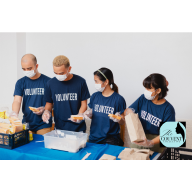
I did not start investing in my community because it was noble. I did it because I noticed something on the road. The operators who lasted, the ones who still had work when the market got tight, were almost always the ones people in their area knew by name. Not knew as a logo. Knew as a person who showed up.
That taught me something that took me years to say out loud. Community investment is not charity you do after the business succeeds. It is part of how the business succeeds in the first place.
The people who know you are the people who refer you
When I first went out on my own, I thought the work would come from being cheaper or faster than the next operator. Some of it did. But most of the work that kept my lights on came from people who already knew me. A dispatcher who remembered I never left her hanging. A shop owner I had helped move a load nobody else would touch. A neighbor who told her cousin, "call him, he is reliable."
None of that shows up on an invoice. All of it shows up in your revenue.
You cannot buy that kind of referral network. You earn it, one relationship at a time, usually before you need it. That is the part people miss. The time to invest in your community is when you do not need anything from it yet.
Investment does not mean money you do not have
I want to be clear, because a lot of small operators hear "invest in your community" and picture writing checks they cannot afford. That is not what I am talking about.
The most valuable thing you can put into your community is your attention and your reliability. Show up to the local business meetup. Answer the question in the group chat when a newer operator is drowning. Refer work to someone when it is not a fit for you. Buy from the vendors down the street before you default to the national account.
Money helps when you have it. But time, knowledge, and a good reputation cost you nothing but the decision to give them, and they compound faster than most people expect.
That said, I do give money too, and I do it in a way that does not depend on having a good year. I built it into the model. I donate 5% of my earnings to nonprofits working in the homeless space, and I chose that space on purpose. When you have spent enough time on the road, you understand how thin the line is between having a place to sleep and not. Setting it at a fixed percentage instead of waiting for a windfall means the giving happens whether the month was strong or lean. It stops being something I will get to someday and becomes something the business already does.
A strong community is a shock absorber
Every business hits a stretch where things go sideways. A truck goes down. A client pays late. A season dries up. When that happened to me, the difference between a rough month and a business-ending month was almost always the people around me.
Someone covered a route so I did not lose the contract. Someone floated me a referral when my pipeline went quiet. Someone told me the truth about a broker before I signed something I would have regretted.
A community you have invested in becomes a cushion when you fall. A community you have only ever taken from does not. The math is that simple, and you usually learn it at the worst possible time if you have not learned it early.
It changes who you are as an operator, not just what you earn
There is a version of running a business where you treat every interaction as a transaction and every other operator as competition. I have watched people run that way. Some of them make money. Almost none of them enjoy the work, and very few of them last a decade.
Investing in your community pulls you out of that. You start seeing yourself as part of something instead of alone against everybody. That is not a soft benefit. Operators who feel connected make better decisions, quit less, and build businesses that are still standing when the ones built on pure self-interest have folded.
How to start this week
You do not need a program or a budget. Pick two things and do them in the next seven days.
Reach out to one person in your industry who is newer than you and offer something useful with nothing attached. An answer, an introduction, a warning about a mistake you already made.
Spend one dollar you were going to spend anyway with a local business instead of a national one, and tell them why you came in.
That is it. Community investment is not a campaign. It is a habit you build in small, repeatable pieces, the same way you built everything else that works in your business.
I will tell you what I told a driver who asked me if any of this was worth it. The strongest thing you can own in this business is not a truck or a contract. It is a room full of people who are glad you exist. You build that room one deposit at a time, and it pays out for the rest of your career.