The Federal Contracting Pipeline Part 7 of 8 | Past Performance - Building a Track Record When You Don't Have One Yet

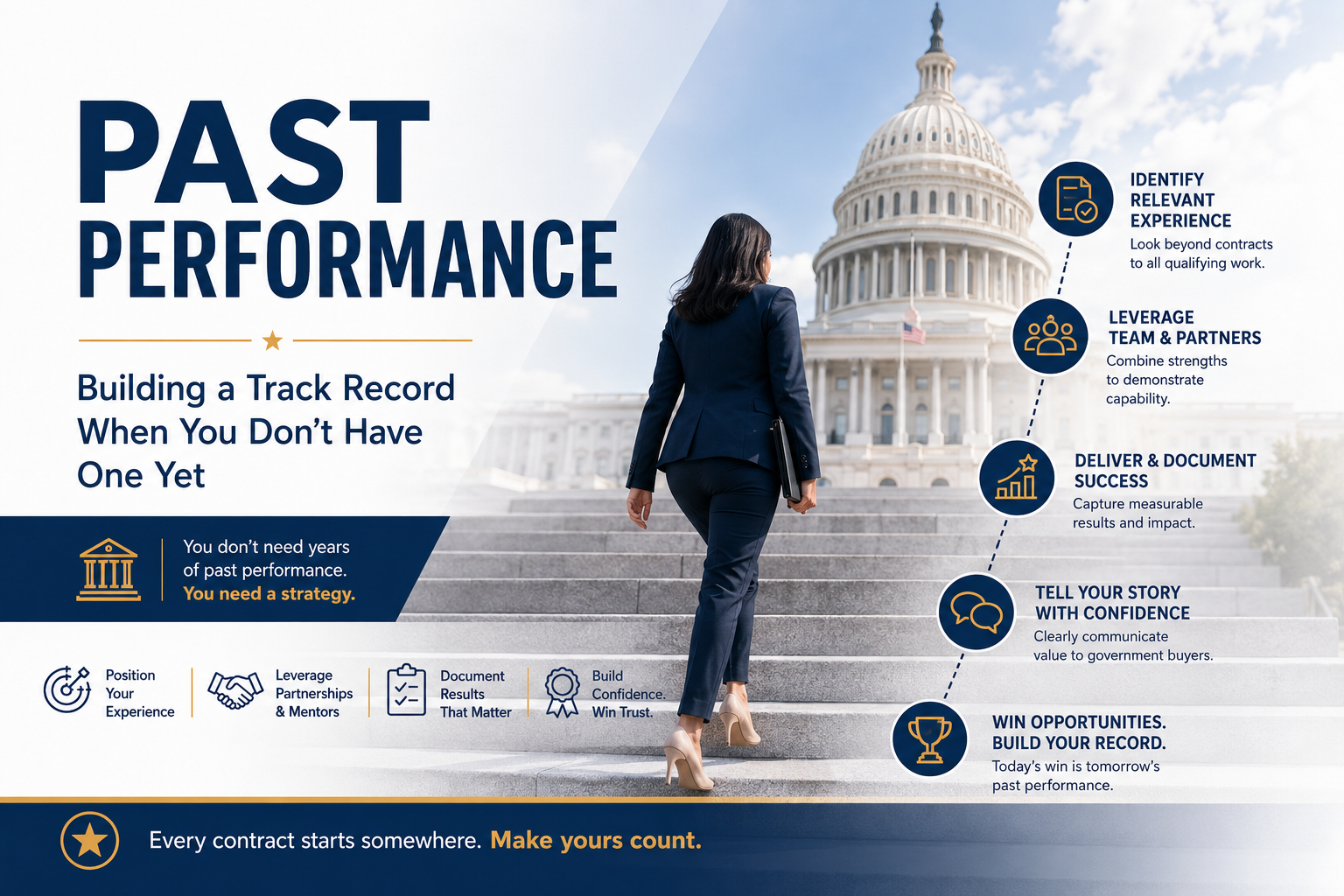
Every new government contractor runs into the same wall: the solicitation asks for past performance on similar contracts, and you don't have any. Not in the federal space, anyway.
This is the catch-22 that stops more small businesses than any other single factor. You can't win a contract without experience. You can't get experience without winning a contract. Except that framing isn't quite right, and understanding why is what gets you past it.
Past performance requirements are not absolute barriers. They're evaluation criteria. And like every evaluation criteria, they can be navigated strategically.
What the Government Is Actually Evaluating
When a contracting officer reviews past performance, they're asking one question: can this contractor deliver? They want evidence that you've done similar work, done it well, and done it reliably.
What counts as "similar" is broader than most small businesses assume. The government is not looking exclusively for identical contracts with federal agencies. They're looking for relevant performance that demonstrates capability, quality, and reliability.
That opens the door significantly.
What Counts as Relevant Past Performance
Commercial Work
Work you've done for private clients can count. If you run a facilities management company and you've managed a 200,000 square foot commercial office complex, that's relevant to a GSA facilities contract, even though your client was a real estate firm, not the Department of Defense.
The key is how you present it. Document scope, scale, dollar value, duration, and outcomes. Treat every significant commercial engagement like it might one day appear in a federal proposal, because it might.
State and Local Government Contracts
State, county, and municipal contracts are strong past performance references. Government work is government work. If you've performed a technology services contract for a state department of revenue, that experience speaks directly to your ability to work within government structures, meet compliance requirements, and perform under public accountability.
Subcontract Performance
If you've worked as a subcontractor on a prime federal contract, that experience is documentable past performance. You may not have been the one signing the contract with the agency, but you performed the work under federal requirements. That matters.
This is one of the most underused sources of past performance for new contractors. If you have subcontract history, capture it — get written references from your prime, document the scope and dollar value of your portion, and record your performance outcomes.
Joint Ventures and Teaming
Work performed as part of a joint venture or formal teaming arrangement can be cited. Be precise about what your entity specifically contributed, and make sure your references can speak to your portion of the performance specifically.
IMPORTANT: When in doubt about whether a piece of experience qualifies, read the solicitation's past performance instructions carefully. Many explicitly state what types of references they will and won't accept. The instructions govern.
How to Document Past Performance Before You Need It
The worst time to think about past performance documentation is when you're writing a proposal under deadline. Build the habit now.
Capture Every Significant Engagement
For each project you complete - commercial, government, or nonprofit - record the following:
• Client name and point of contact
• Contract or engagement value
• Period of performance
• Scope description in plain, searchable language
• Key deliverables and outcomes
• Any measurable results: cost savings, timeline performance, quality metrics
• Client satisfaction data, if available
Store this in a format you can pull from quickly. A simple spreadsheet or shared document works. The point is having it when you need it, not reconstructing it from memory six months after the engagement ended.
Get References in Writing
Ask clients for a brief written statement while the work is fresh. Not a formal letter of recommendation - just a clear statement of what you did, how you performed, and what the outcome was. A few sentences from a satisfied client is worth more in a proposal than a paragraph of self-description.
Federal proposals often include a section where the contracting officer contacts your references directly. A client who can't remember the details of your engagement two years later is a weak reference. Keep them warm.
CPARS - Know It Exists
The Contractor Performance Assessment Reporting System (CPARS) is the federal government's formal system for rating contractor performance on federal contracts. Once you have federal work, your agency will rate your performance in CPARS. Those ratings follow you and are visible to contracting officers reviewing future proposals.
Performing well isn't enough, you need to know when you're being rated, communicate with your contracting officer throughout performance, and respond formally to any ratings you disagree with. Your CPARS record is a long-term asset or liability depending on how seriously you manage it.
Competing Against Incumbents With Longer Histories
The incumbent advantage is real. A contractor already performing the work has an established relationship with the agency, institutional knowledge of the requirement, and a CPARS record the government can point to. You're asking the contracting officer to take a risk on someone new.
Here's how to reduce that perceived risk.
Lead With Capability, Not Just Experience
If your past performance record is thinner, your technical approach and management plan have to be stronger. Show, specifically, how you will perform this work. Not that you've done something like it before. That you have a clear, detailed plan for doing this.
A well-constructed technical approach signals that you understand the requirement at a level that goes beyond surface familiarity. Contracting officers notice when a proposal reads like someone actually thought through the work.
Find the Gaps in the Incumbent's Record
No incumbent is perfect. Before you submit, research their performance history. CPARS ratings from previous contracts may be discoverable through FOIA requests. Past agency reports, inspector general findings, and Government Accountability Office records are public. You're not attacking, you're positioning your differentiation based on what the current contract has failed to deliver.
If the incumbent has had delivery issues, your management plan should speak directly to how you handle those risks. Don't name the incumbent. Just address the problem with a better solution.
Use the Offeror's Past Performance Questionnaire Strategically
Most solicitations include a Past Performance Questionnaire (PPQ) that your references fill out and submit directly to the contracting officer. Choose references who can speak specifically to the work in this solicitation. Brief your references before they submit, remind them of the scope of your work together and what outcomes you delivered. A generic reference hurts. A targeted, specific one helps.
Consider the First Rung - Subcontracting to Build Federal History
If you don't have federal past performance yet, the fastest path to building it is working under a prime. Pursue subcontracting opportunities with established federal contractors who have set-aside obligations or mentor-protege relationships. Perform well. Get documented. Use that performance as the foundation for your next proposal as a prime.
It's not the fastest path to a prime contract. But it's a legitimate, low-risk way to start building the track record that opens those doors.
Past performance is an evaluation factor, not an insurmountable wall. Document what you have, present it strategically, and build deliberately toward the record you need. The contractors who get past this barrier aren't the ones with the longest histories. They're the ones who understand what the government is actually looking for.
Up Next in Part 7: Teaming and Subcontracting - How to Get on Contract When You Can't Win One Alone. We'll cover mentor-protege agreements, subcontracting plans, and how to build teaming relationships that open doors instead of closing them.
© 2026 Published by Evans Cutchmore, an Imprint of The Couvent Collective PBC. All rights reserved.
Kim M. Braud is a strategist, writer, and founder working in the areas of economic power, cultural narrative, and community leadership. With expansive experience across financial services, entrepreneurship, and nonprofit leadership, her writing explores who controls systems, who benefits from them, and who gets left out. Her work centers on economic mobility, institutional accountability, and the stories we inherit, and the ones we choose to dismantle.
Before You Submit, Get a Strategic Eye on Your Response
Responding to an RFP without a strategic review is one of the fastest ways to lose a contract you were qualified to win. Evaluators score on specifics, and most responses miss the mark not because the business is not capable, but because the response did not speak the language of the solicitation.
This service is for founders and business owners who have an RFP in hand and need an experienced advisor to review the document, identify what evaluators are actually looking for, and provide structured feedback on their draft response before it is submitted.
What is included: Full review of the RFP or solicitation document. Written feedback on your draft response covering alignment, gaps, tone, and scoring criteria. Actionable notes on sections that need strengthening. One follow-up exchange via email to address questions after feedback is delivered. One-hour review session.
This is for you if: You are responding to a government, corporate, or institutional RFP and you have a draft response ready for a second set of strategic eyes before submission.
Not included: Full response writing or rewriting. If you need a response written from scratch, contact us to discuss a custom engagement.
Turnaround: 3 to 5 business days from receipt of documents. A list of qualifying questions will be forwarded to you within 24 hours, followed by a scheduled Zoom prior to delivery of recommendations.