How to Read and Respond to a Government RFP (And What to Actually Look For)

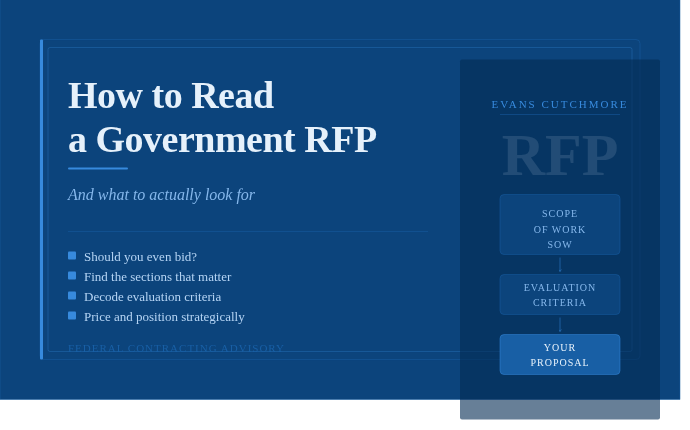
Most businesses approach a government RFP like it is a form to complete. That mindset is exactly why so many proposals fail. An RFP is not just a document. It is a roadmap written by a buyer that tells you what they need, how they think, what they value, and how they will decide who wins. When you learn how to read it strategically, you stop reacting and start positioning.
Start With This: Should You Even Bid?
Before you write a single word, you need to decide if this is a real opportunity or a distraction. Not every RFP is worth your time, and chasing everything will slow your growth instead of accelerating it. Strong contractors are selective and intentional about what they pursue.
Look at:
- Scope of work - can you actually deliver this at a high level?
- Past performance requirements - do you have relevant experience?
- Timeline - can you meet it without stretching your operations thin?
- Set-aside status - is this meant for small, minority, or woman-owned businesses?
If the answer is no or unclear in multiple areas, the opportunity may not be aligned. The goal is not to bid more. The goal is to win more.
Find the Sections That Actually Matter
Most people start at page one and read straight through, which is the slowest way to understand an RFP. Instead, go directly to the sections that control your strategy and your score.
Go straight to:
- Scope of Work / Statement of Work (SOW)
- Instructions to Offerors
- Evaluation Criteria
- Submission Requirements
These four sections will tell you everything you need to know about how to respond and how your proposal will be evaluated. Once you understand these, the rest of the document becomes context instead of confusion.
Read the Scope Like a Buyer, Not a Vendor
The Scope of Work is where the agency defines what they need, but it is also where they reveal the problem they are trying to solve. Many businesses repeat this section back in their proposal, which does nothing to differentiate them. Your role is to interpret it and show deeper understanding.
Don’t just read what they are asking for. Read between the lines:
- What problem are they really trying to solve?
- Where are the risks?
- What would success look like to them?
When you answer those questions in your proposal, you move from being a vendor to being a solution.
Follow Instructions Like Your Contract Depends On It
The Instructions to Offerors section is where a large number of proposals are eliminated before they are even evaluated. This is not about creativity. This is about compliance. If you do not follow directions exactly, your proposal may never be scored.
This section will tell you:
- Format requirements
- Page limits
- Required documents
- How to organize your response
- Submission deadlines and method
Every requirement should be treated as mandatory. Precision in this section is one of the easiest ways to separate yourself from the competition.
Decode the Evaluation Criteria
The Evaluation Criteria is the most important section in the RFP because it tells you how the agency will make its decision. This is where many businesses go wrong because they write based on what they want to say instead of how they will be scored.
You need to understand what carries the most weight. If technical capability is the priority, your response should clearly demonstrate how you will execute the work. If past performance is heavily weighted, your examples should be specific and directly relevant. If pricing is a major factor, your numbers must be aligned with your approach and justified.
Your proposal should be built around this section. When you align your response to the evaluation criteria, you make it easier for the agency to choose you.
Build Your Response for the Evaluator
Your proposal should mirror the structure of the RFP. Evaluators are reviewing multiple submissions, often under tight timelines. The easier you make it for them to find your answers and assign scores, the stronger your position becomes.
Each section of your proposal should clearly answer what was asked and reinforce that you are the most capable and lowest risk option. Clarity and alignment will always outperform unnecessary complexity.
Price Strategically
Pricing is not about being the lowest. It is about being credible. Your pricing should align with your technical approach and reflect the level of effort required to deliver the work successfully.
If your price is too low, you create doubt about your ability to perform. If your price is too high without explanation, you remove yourself from consideration. Strong proposals connect price to value and execution, not just numbers.
Always Request a Debrief
If you do not win the contract, the process is not over. Requesting a debrief gives you direct insight into how your proposal was evaluated. You will learn where you performed well, where you lost points, and how you compared to the selected vendor.
This is one of the most valuable tools for improving your future proposals, yet it is often overlooked. Businesses that consistently request debriefs improve faster and compete more effectively over time.
Government contracting is not about submitting more proposals; it is about submitting stronger ones. When you learn how to read an RFP properly and structure your response around what the agency actually values, you stop guessing and start competing with intention.
If you are ready to move from reading RFPs to winning them, Evans Cutchmore's Federal Opportunity Intelligence service was built for exactly this stage. We monitor the federal marketplace on your behalf, filter for fit, and deliver a weekly curated brief with NAICS breakdowns, set-aside details, and expert pursuit assessments - so you spend your time on the opportunities that are actually worth pursuing. Whether you need the intelligence alone or a strategic partner in your corner, we have a tier built for where you are right now.